

12-13 May 2026
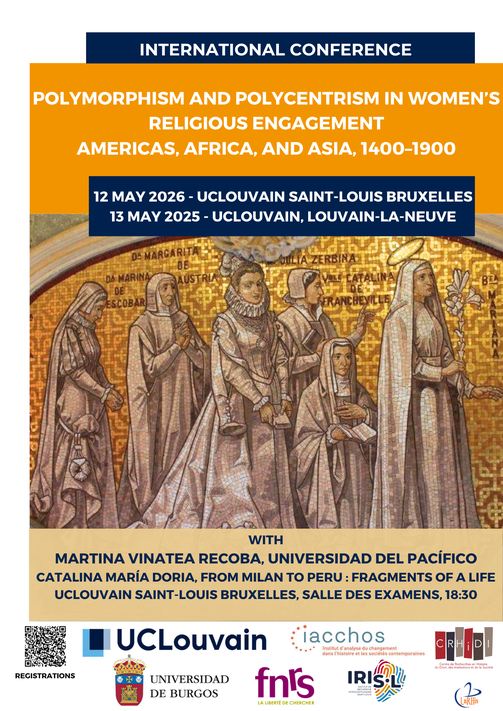
This conference will examine the manifestations of religiosity of women who were not fully considered by the Catholic Church as members of its body, such as beatas, consecrated virgins, beguines, bizzoche, penitents, tertiaries, puellae, as well as sisters of religious congregations, from 1400 to 1900.
These women will be examined from the perspective of the Americas, Africa, and Asia. As many of these global experiences are closely tied to colonising states, Europe will only be considered in relation to these non-European cases. The aim is to integrate these models of religious life into the cultural, religious, social and economic history of women religious and devout laywomen, who have often been sidelined in favour of cloistered nuns. The long chronological period considered will highlight continuities and ruptures beyond the confessional age.
The main objective of this collaboration between two international initiatives, ISHWRA (International Scholars for the History of Women Religious Association) and Sorores (SORORES. Les religieuses non cloîtrées en Europe du Sud, XIIe-XVIIIe siècles), is to look, on a global scale, at women who were engaged in models of religious life that have been under-researched due to the ambiguity of their status and their presence on the margins of monastic institutions, or because of the scarcity of sources.
12 May 2026
Salle des Examens
UCLouvain Saint-Louis Bruxelles
Boulevard du Jardin Botanique, 43 - 1000 Brussels
13.45
Introduction : Sarah Barthélemy and Liliana Pérez Miguel
14.00-15.45
SESSION 1 How Women’s Religious Commitment is Experienced and Defined
14:00 - Yolande François (Université Jean Moulin Lyon 3)
Jewish Female Religiosity as a Matrix of Christian Models: Rethinking Women’s Religious Polymorphism in a Longue Durée Perspective (Antiquity–Modernity)
14:20 - Ji Li (The University of Hong Kong)
Chinese Christian Virgins: Adaptation, Contribution, and Identity
14:40 - Tiffany Hunsinger (University of Dayton)
Between Cloister and Community: Beatas and Laywomen in Colonial Mexico as Agents of Polymorphic Catholicism
15:00 - Sofía Brizuela (UNSTA) & Óscar Leonardo Londoño (Universidad Nacional de Colombia)
Del hecho prodigioso a la institucionalidad. La beata María Ramos y el culto a la Virgen de Chiquinquirá
Discussion
Coffee Break
16.00-18.10
SESSION 2 How women’s religious commitment is controlled, debated, or prosecuted
16:00 - Julia Lewandowska (Uniwersytet Warszawski)
La Santita: Gender, Mystical Theology, and the Prism of Sanctity. The Case of Beata Josefa Romero (1620–1655) in the Viceroyalty of New Spain
16:20 - Esther Borauzima Feza (UCLouvain)
Kimpa Vita et le messianisme kongo : Subversion religieuse, agency féminine et résistance anticoloniale au XVIIIe siècle
16:40 - Luis Rodríguez Toledo (PUCP / UNMSM)
“¿A qué vienes puta, a atormentarnos?”. Ángela de Carranza, el buen gobierno y la mala burocracia en el Perú, 1673–1689
17:00 - Laura Montoya Upegui (Universidad de los Andes)
Between Support and Distrust: “Women Only Spend on Ribbons and Feathers” (Antioquia, 1886–1954)
17:20 - Rimliya Tariq Telkenaroglu (McGill University)
Demoniac, Witch, or the Living God? The Female Quaker Minister in Early Modern England
17:40 - Discussion
18:30
Keynote Speaker
Martina Vinatea Recoba (Universidad del Pacífico)
Catalina María Doria, from Milan to Peru : Fragments of a Life
13 May 2026
Learning Center Christine de Pizan - Salle flexible 2
UCLouvain, campus Louvain-la-Neuve
11.00-13.00
SESSION 3 How women’s religious commitment is embedded in and acts within society
11.00 - Marya Svetlana T. Camacho (University of Asia and the Pacific)
For Sound Doctrine and the Holy Fear of God: The Beaterio de la Compañía in Eighteenth-Century Manila
11.20 - Patrick Romuald Jie Jie (Université de Bertoua)
Vie religieuse et statut des femmes catholiques du “Sixa”: Entre aspiration conjugale et dévotion religieuse au Cameroun colonial (1890–1960)
11.40 - Liliana Pérez Miguel (Universidad de Burgos)
Jacinta Montoya: Networks and the Political Agency of Lima’s Religious Women in the Seventeenth Century
12.00 - Ariel J. Morrone (CONICET / Universidad de Buenos Aires)
Dos beatas, dos estampas. Religiosidad local y redes de poder en Jesús de Machaca (obispado de La Paz, Charcas), siglos XVII–XVIII
12.20 - Discussion
Lunch and coffee break
14.30-16.30
SESSION 4 How women’s religious commitment circulates and is transformed globally
14.30 - Elena Manchado Rodríguez (Museo Naval de Madrid)
Gesuitesse, Pregadoras and Apóstoles: Women Evangelizers in the Seventeenth-Century Asian Pacific
14.50 - Sarah Barthélemy (UCLouvain Saint-Louis Bruxelles)
Beatas, Demoiselles and the Spiritual Exercises for Seventeenth- and Eighteenth-Century Women. Manila, Vannes and Córdoba
15.10 - Adriana G. Alonso Rivera (Benemérita Universidad Autónoma de Puebla)
La identidad Nazarena femenina y su dimensión performática: de la laicidad a la institucionalización agustiniana y carmelitana (siglos XVII–XVIII)
15.30 - Discussion
15.45 - Closing round-table discussion moderated by par Isabel Harvey (UCLouvain / UQAM)

Organising committee
Sarah Barthélemy (UCLouvain Saint-Louis Bruxelles)
Annick Delfosse (ULiège)
Philippe Desmette (UCLouvain Saint-Louis Bruxelles)
Isabel Harvey (UCLouvain / UQAM)
Silvia Mostaccio (UCLouvain)
Liliana Pérez Miguel (Universidad de Burgos)
Scientific committee
Cormac Begadon (Durham University)
Gemma Betros (Australian National University)
Sylvie Duval (Università di Bologna)
Sergi Sancho Fibla (Université de Clermont-Ferrand)


Centre de recherches en histoire du droit, des institutions et de la société
Actualités
jeu.
11
juin
2026
Compte-rendu du colloque "Au bord des mondes. Par-delà les savoirs hégémoniques"
Lire la suitelun.
01
juin
2026
Midi CRHiDI : Récits en mouvement d’empires de pierre. Une histoire de longue durée de la (dé)commémoration coloniale dans l’espace public italien et belge
Lire la suitemar.
12
mai
2026
International Conference : Polymorphism and Polycentrism in Women’s Religious Engagement Americas, Africa, and Asia, 1400–1900
Lire la suitelun.
11
mai
2026
Midi CRHiDI : Le miracle fait texte. Lire l’expérience dévotionnelle à travers les récits de miracles mariaux (Pays-Bas méridionaux, XVIIe siècle)
Lire la suitejeu.
07
mai
2026
Séminaire de formation et de réflexions sur les théories et approches décoloniales - D-Centre
Lire la suitemer.
06
mai
2026
Conference LHS : Claimed Seas: Sovereignty, Freedom and the Making of International Law (ca. 1350-1800)
Lire la suitelun.
13
avril
2026
Midi CRHiDI : Les administrateurs territoriaux belges dans le miroir burundais : une lecture onomastique des perceptions coloniales (1916 -1962)
Lire la suitemar.
24
mars
2026
Conférence : Immigration marocaine en Belgique : trois générations d'histoires familiales et de vie associative
Lire la suitejeu.
12
mars
2026
Séminaire de formation et de réflexions sur les théories et approches décoloniales - D-Centre
Lire la suitemar.
17
févr.
2026
Séminaire : Figures/Visages de l'administration dans l'Europe des crises politiques (XVIe-XXIe siècles)
Lire la suitelun.
09
févr.
2026