

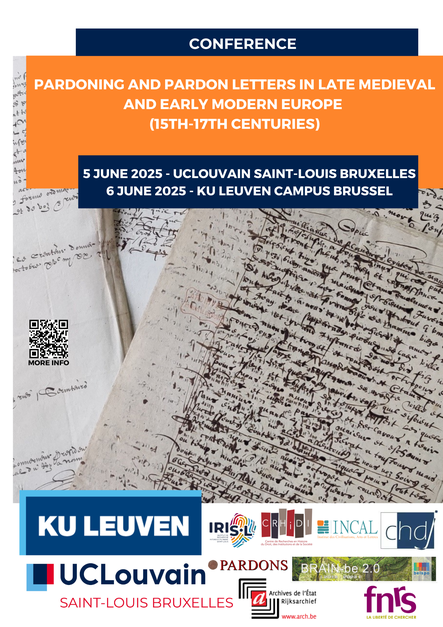
5-6 June 2025. UCLouvain Saint-Louis Bruxelles and KU Leuven Campus Brussel.
Scientific Committee
· Prof. Éric Bousmar (UCLouvain Saint-Louis Bruxelles)
· Prof. Hans Cools (KU Leuven)
· Lieve De Mecheleer (State Archives of Belgium)
· Dr Gert Gielis (State Archives of Belgium)
· Dr Luke Giraudet (KU Leuven)
· Prof. Eddy Put (State Archives of Belgium)
· Prof. Xavier Rousseaux (UCLouvain)
· Dr Quentin Verreycken (UCLouvain)
· Prof. Alexis Wilkin (ULB)
Since the work of Natalie Zemon Davis, Robert Muchembled and Claude Gauvard, historians have turned to the analysis of pardon letters to interrogate not only the workings of premodern violence, but also the everyday life, habits and cultural assumptions of those who petitioned for mercy. While large-scale quantitative surveys of legal records have long been a staple of the history of crime and justice, new methodological advances coupled with developments in the digital humanities have increasingly enabled historians to reconcile the analysis of huge swathes of archival data with the more grounded approaches characteristic of microhistory, zooming in upon regions, periods and outlier examples to establish nuanced accounts of violence in its social, political and religious contexts.
A collaborative and multi-institutional project, PARDONS is situated precisely within this trend, and over the past few years has harnessed technological advances in order to digitize, transcribe and analyse the late medieval and early modern pardon letters held in central Belgian archives. Organized by the Belgian National Archives, the Centre d’histoire du droit et de la justice (CHDJ/UCLouvain) and the Early Modern Research Group (KU Leuven), with the support of the Centre de recherches en histoire du droit, des institutions et de la société (CRHiDI/UCLouvain Saint-Louis Bruxelles), this conference aims to consolidate new insights and foster dialogue between scholars working on the history of violence, crime, and royal mercy in Western Europe.
Outline of the Programme of the Pardons Conference
Day 1 – 5 June 2025 (UCLouvain Saint-Louis Bruxelles)
UCLouvain Saint-Louis Bruxelles
Room P02 (Rez-de-chaussée)
Rue du Marais, 119 - 1000 Brussels
8.30-9.00 - Coffee & Opening Remarks: Xavier Rousseaux
9.00-10.30 - Session 1: Pardons between theory and practice
- Krista Kesselring (Dalhousie University): A Crowning Mercy? The Coronation Pardon in English History
- Dylan Beccaria (Université d’Aix-Marseille): ‘Une stupide bonté et une simplicité sans prudence’. Raison d’État, dangers et limites de la grâce dans le Conseiller d’État de Philippe de Béthune (1633)
- Nicolas Ruys (UCLouvain): Lettres d’état et affaires criminelles, un mariage impossible ? Etude du tractatus de literis dilatoriis, annalibus, quinquennalibus, status, & aliis, in iudiciis frequens de Pierre Rebuffe (1487-1557)
10.30-10.45 - Coffee Break
10.45-12.15 - Session 2: Gendered Stories and Violence
- Elias Feys (KU Leuven & Université de Lille): ‘A Hot-tempered, Capricious, Jealous and Compassionnless wife’. Marital Conflicts and Homicide in Pardon Letters from Burgundy and the Low Countries (1450-1535)
- Sara McDougall (John Jay College of Criminal Justice – CUNY): Pardonable Women : What's gender fot to do with it? - 15th century France
- Elma Brenner (Wellcome Collection): Gender and mental illness in a pardon letter from fifteenth-century Normandy
Lunch - 12.15-13.00
13.00-14.00 - Session 3: Peacemaking and Pardons
- Stuart Carroll (University of York): The Politics of Peace-Making in a Seventeenth-Century French Village
- Diane Roussel (Université Gustave Eiffel – Champs-sur-Marne): Faire la paix: pratiques et échecs de la composition dans les lettres de rémission françaises du XVIe siècle
14.00-14.45 - Keynote lecture
Keynote lecture by Walter Prevenier (Universiteit Gent): Fascination with Pardon Letters before and since Natalie Zemon Davis: the endless archival searching, the unveiling of petitioners' and princes' motivations
14.45-15.00 - Coffee break
15.00-16.30 - Session 4: War and Justice
- Quentin Verreycken (FNRS – UCLouvain): Conflicting Loyalties: Pardon Letters and Borderland Military Violence during the French-Burgundian Wars, 1465–1482
- David Fiasson (CY Cergy Paris Université): ‘Une coquinaille qui ne sont bons que a destruire le peuple.’ Pages et valets de guerre d'après le témoignage des lettres de rémission (France, première moitié du XVe s.)
- Pierre Prétou (La Rochelle Université): Les temporalités du pardon de la désobéissance dans le Sud-ouest du Royaume de France au XVe s., entre traitement de l’ennemi, du rebelle ou du criminel
16.30-16.45 - Coffee break
16.45-18.15 - Session 5: Pardons and Fictionalization
- Luke Giraudet (KU Leuven): Witnessing Violence: Collective Storytelling and the Crafting of Pardon Tales in the Habsburg Low Countries
- Xavier Rousseaux (UCLouvain) & Julie Douley (UCLouvain): ‘S’est avanchié ledict bailly de laisser la voye de faict... en les gectant en prison très estroicte et rude, au fon de fosse et ceppe de fer ...’ Imprisonment stories in pardon letters from the Southern Netherlands (15th-18th c.)
- Antoine Fersing (Université de Strasbourg): L’exercice de la grâce, un facteur de la construction des problèmes publics durant la première modernité ? Le cas de la régulation de la consommation d’alcool en Lorraine ducale au début du XVIIe siècle
18.15-18.45 - Round Table – Book Launch: V. Soen & Y. Junot eds., Pardons and Peacemaking in the Spanish Habsburg World (Habsburg Worlds 7) (Brepols, 2025). Respondents: Gert Gielis (Belgian State Archives), Luke Giraudet (KU Leuven), Quentin Verreycken (FNRS – UCLouvain)
18.45-19.15 - Reception
20.00 - Conference dinner
Day 2 – 6 June (KU Leuven Campus Brussel)
KU Leuven – Campus Brussels
Room 6306 (6th floor, lift)
Rue du Mont aux Herbes Potagères 43 - 1000 Brussels
9.00-10.00 - Visit to the Belgian State Archives (Ruisbroekstraat)
- Gert Gielis (Belgian State Archives) & Lieve de Mecheleer (Belgian State Archives): Presentation of the project & showpieces
- Anica Rimac (UCLouvain): Showcase of PARDONS resources
10.00-11.00 - Transfer to the Warmoesberg & Coffee Break
11.00-12.30 - Session 5: Pardons and Religion
- Hans Cools (KU Leuven): A tale of unrest and uncertainty. The pardon for Jehan le Roy in 1562
- Violet Soen (KU Leuven): Pardon Letters and the Storytelling of Refugees Returning to the Habsburg Low Countries during the Revolt
- Eduardo Benítez-Inglott y Ballesteros (Oxford University): ‘Sub Sigillo Officium Penitentiarie’: The Apostolic Penitentiary, Its Pardon Letters, and the Spanish Inquisition – A Case Study
12.30-13.15 - Lunch
13.15-14.45 - Session 6: The imperfect monopolization of violence over time and space I
- Rudi Beaulant (Université Marie et Louis Pasteur – Besançon): Les premières lettres de rémission de Philippe le Hardi. Réflexion sur la mise en place de l'administration du droit de grâce sous le premier duc Valois
- Maurena Benteboula (Université de Lille): 'Il ne demandoit que paix et amour' : l’utilisation des réseaux de pouvoir princiers dans l’obtention du pardon à travers l’exemple d’Antoine Grand Bâtard de Bourgogne
- Emmanuel Gerardin (Université de Strasbourg): La grâce des ducs de Lorraine, un instrument au service de la construction d’une justice souveraine (fin XVe-début XVIIe siècle)
14.45-15.00 - Coffee break
15.00-16.30 - Session 8: The imperfect monopolization of violence over time and space II
- Mark Spindlow (University of York): Pardons and dispute settlement in England after the civil war, 1660-1700
- Antoine Follain (Université de Strasbourg): La grâce, une prérogative souveraine dégradée en Lorraine après 1630
- Bernard Dauven (UCLouvain): La grâce est morte? Vive la grâce! Les évolutions de la grâce à l'époque moderne dans les Pays-Bas (XVIe-XVIIIe siècles). Typologie et formulaires
16.30 –17.00 - Closing Remarks/Conclusions
Drink
Poster session: Arthur Watillon, Jeremy Sidgwick, Richard Gaudier, Arne Vinck, Dries De Buck, Xavier Gillard
Registration mandatory via this form before 03/06/2025 :
https://forms.office.com/e/tr5dzE0djF
Please indicate which day(s) you will be attending and whether you will be taking part in the lunches.


Centre de recherches en histoire du droit, des institutions et de la société
Actualités
jeu.
11
juin
2026
Compte-rendu du colloque "Au bord des mondes. Par-delà les savoirs hégémoniques"
Lire la suitelun.
01
juin
2026
Midi CRHiDI : Récits en mouvement d’empires de pierre. Une histoire de longue durée de la (dé)commémoration coloniale dans l’espace public italien et belge
Lire la suitemar.
12
mai
2026
International Conference : Polymorphism and Polycentrism in Women’s Religious Engagement Americas, Africa, and Asia, 1400–1900
Lire la suitelun.
11
mai
2026
Midi CRHiDI : Le miracle fait texte. Lire l’expérience dévotionnelle à travers les récits de miracles mariaux (Pays-Bas méridionaux, XVIIe siècle)
Lire la suitejeu.
07
mai
2026
Séminaire de formation et de réflexions sur les théories et approches décoloniales - D-Centre
Lire la suitemer.
06
mai
2026
Conference LHS : Claimed Seas: Sovereignty, Freedom and the Making of International Law (ca. 1350-1800)
Lire la suitelun.
13
avril
2026
Midi CRHiDI : Les administrateurs territoriaux belges dans le miroir burundais : une lecture onomastique des perceptions coloniales (1916 -1962)
Lire la suitemar.
24
mars
2026
Conférence : Immigration marocaine en Belgique : trois générations d'histoires familiales et de vie associative
Lire la suitejeu.
12
mars
2026
Séminaire de formation et de réflexions sur les théories et approches décoloniales - D-Centre
Lire la suitemar.
17
févr.
2026
Séminaire : Figures/Visages de l'administration dans l'Europe des crises politiques (XVIe-XXIe siècles)
Lire la suitelun.
09
févr.
2026